
Saudi Arabia’s Article 74: The 9 Traffic Violations That Can Now Lead to Expat Deportation
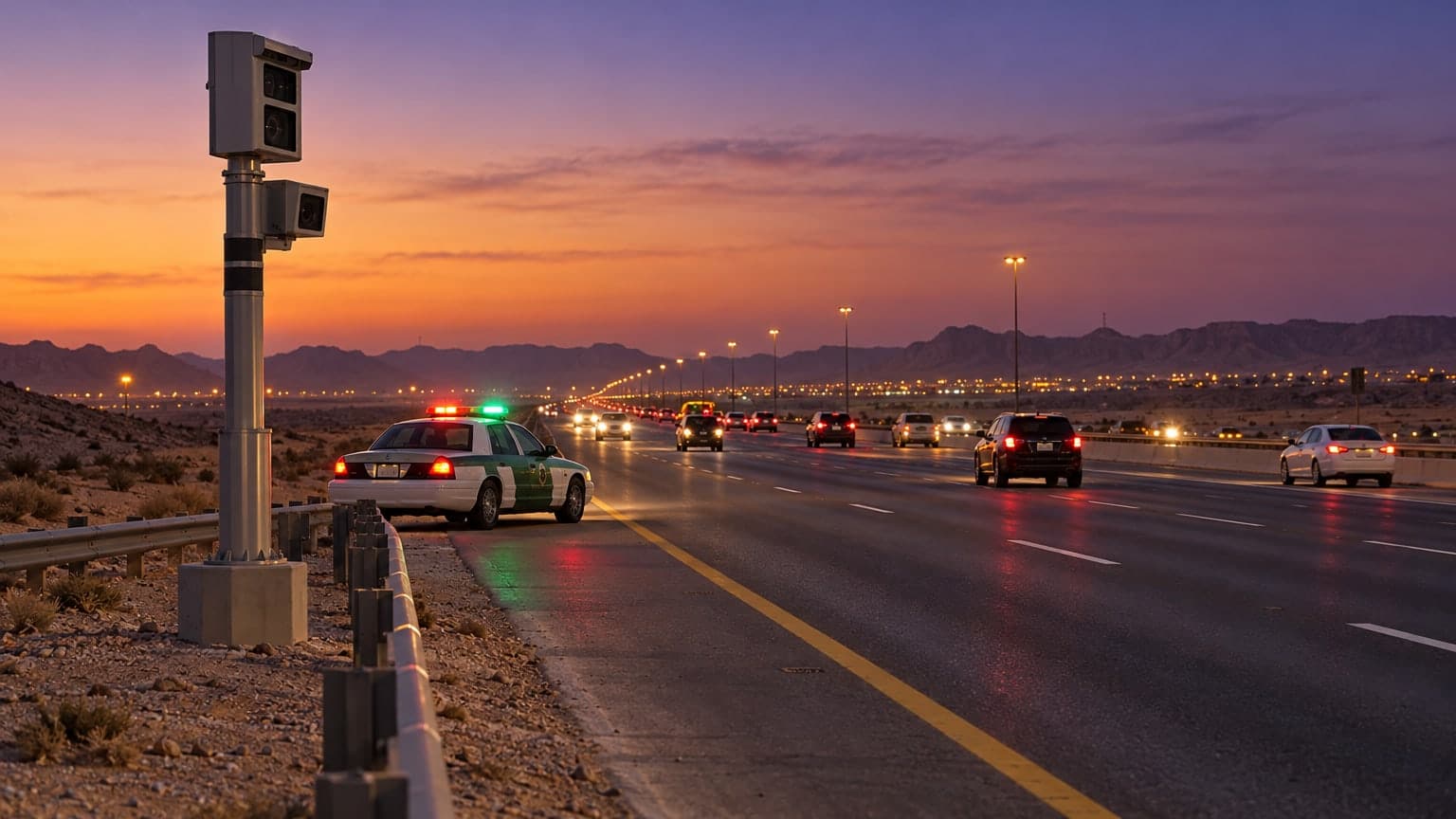
Since Royal Decree No. M/50 rewrote Article 74 of the Saudi Traffic Law, the Ministry of Interior holds the power to deport any non-Saudi who is convicted, by a final court ruling, of a traffic violation that endangers public safety, and to bar that person from entering the Kingdom again. For the roughly 13 million foreign residents of Saudi Arabia, a driving offense can now cost a person the right to live and work in the country.
The decree was approved by the Council of Ministers on August 19, 2025 and published in the official gazette Umm Al-Qura on September 5, 2025. Coverage recirculated through Gulf media in the first week of November 2026.
What Article 74 says now
Article 74 of the Traffic Law has existed since 2007 as the Kingdom’s escalation rule for dangerous driving: repeat offenders face steeper fines and eventually a judge. The 2025 amendment kept that ladder and added a paragraph that applies only to non-Saudis.
Before the amendment (2007 text)
- Second endangering violation within one year: fine at its maximum limit.
- Third violation within the same year: referral to a competent court, with up to one year of imprisonment or a doubled second-offense fine.
- Applied to every driver, Saudis and residents alike.
- No deportation power anywhere in the article.
After Royal Decree M/50 (in force since Sept 5, 2025)
- Same strike ladder, unchanged for everyone.
- New: after a final court ruling convicting a non-Saudi of any endangering violation, the Ministry of Interior may deport that person and prevent them from entering the Kingdom again.
- Deportation controls are set by the Ministry of Interior in coordination with the ministries of Foreign Affairs and Justice and the Public Prosecution.
- The executive regulation must name the categories exempted from deportation.
Two words in the new text carry the legal weight. The deportation paragraph is triggered by a final conviction for any one of the listed violations, so a repeat offense is not required. And deportation is a discretionary power: the Ministry of Interior may deport, acting under controls coordinated across four agencies.
The nine violations that count
The Traffic Law tells the executive regulation to define exactly which violations endanger public safety, and the regulation’s current Article 74 lists nine. This list is what a court and the Ministry of Interior work from. Translated from the current Arabic text (updated October 2026):
| Clause | Violation | Fine range (SAR) | License points |
|---|---|---|---|
| 1/1/74 | Speeding by more than 30 km/h over the limit on roads with a 140 km/h limit | n/a | n/a |
| 2/1/74 | Speeding by more than 50 km/h over the limit on roads limited to 120 km/h or less | n/a | n/a |
| 3/1/74 | Driving under the influence of alcohol, drugs, or medication labeled as impairing for driving | 5,000–10,000 (Table 7) | 5 |
| 4/1/74 | Carrying out road works before coordinating with the competent traffic department | n/a | n/a |
| 5/1/74 | Crossing a traffic signal during the red light | 3,000–6,000 (Table 6) | 5 |
| 6/1/74 | Driving a vehicle against the direction of traffic | 3,000–6,000 (Table 6) | 5 |
| 7/1/74 | Exceeding the permitted load dimensions on heavy transport vehicles | n/a | n/a |
| 8/1/74 | Overtaking in no-overtaking zones such as curves and hill crests | n/a | n/a |
| 9/1/74 | Carrying passengers in places not designated for them in the vehicle | n/a | n/a |
A few entries sit outside what most drivers picture as dangerous driving. Running a red light, an offense many drivers treat as an expensive fine and nothing more, is an endangering violation under clause 5/1/74. So is driving against traffic for even a short distance. And the list reaches beyond moving violations: a contractor who performs road works without coordinating with the traffic department is inside the same article.
Drifting (tafheet) is absent from the list. It is policed under a separate provision of the Traffic Law with its own penalties, so it does not appear in the Article 74 endangering list. That distinction matters if you are trying to assess where your own situation stands.
The strike ladder: 12 months, same violation, steeper every time
Every driver in Saudi Arabia, Saudi or foreign, sits under the escalation rule in paragraph 1 of the amended Article 74. The regulation adds three details that define how the ladder is computed.
within 12 months
within the same year
How a deportation case happens
Several gates stand between a traffic fine and deportation, and a case can stop at any of them. This is the sequence the amended law sets out:
Deportation for road offenses has precedent in Saudi Arabia. The General Authority for Transport has already applied deportation penalties against drivers operating illegal passenger transport, under the parallel Land Transport System. What Article 74 does is bolt a comparable consequence onto ordinary traffic law for dangerous driving.
The questions expats keep asking
A speed camera caught me going 20 km/h over. Can I be deported for that?
No. Ordinary speeding below the regulation’s thresholds (more than 30 km/h over on a 140 road, more than 50 km/h over on a 120-or-lower road) is not on the endangering list, and deportation also requires a final court conviction, which a routine administrative fine does not produce.
What about running a red light or driving the wrong way?
Both are on the list. Paying the fine resolves the administrative record, but if the matter goes to court and ends in a final conviction, the deportation power is engaged. If you are charged and referred to court for either offense, get legal advice before you take any step.
Is the deportation automatic once a court convicts me?
No. The ministry “may” deport, under controls coordinated with three other agencies, and the regulation is required to carve out exempt categories. In practice, the outcome of any case depends on those controls, which have not been made public. The risk is real, and it is administered case by case.
Does any of this apply to Saudi citizens?
The deportation paragraph applies only to non-Saudis. The strike ladder, the maximum fine on the second offense, and the court referral on the third apply to every driver.
When did this take effect?
The amended Article 74 entered force when the decree was published in Umm Al-Qura, on September 5, 2025. The regulation-level provisions have been updated in stages since, and Gulf media recirculated the story this week, which is why you may be hearing about it now.
What to do if you are cited for a serious violation
In the days after a serious citation, the law gives drivers specific windows and tools:
1. Pull the record on Absher the same day
Check the violation’s classification, the fine range, and whether it is logged under one of the nine endangering categories. The record tells you which regime you are in.
2. Decide on an objection inside the window
Under the Traffic Law, a driver who disputes a violation has 30 days from the date it was recorded to object. If the violation is misclassified, wrong, or not yours, the objection period is your only structured chance to fix the record before it becomes part of your history.
3. Treat any court referral as a residency matter
If the case is going to court, a conviction for an endangering violation now has immigration consequences for a non-Saudi. At this point, bring in a lawyer familiar with traffic and residency law. Do not handle it the way you would handle a routine fine.
4. Watch your points and your 12-month window
Each Table-6 or Table-7 violation adds 5 points, and 90 points within three years triggers license suspension. Separately, the strike ladder resets 12 months after your first endangering offense. You can see both counts in your own record.
Sources
- Council of Ministers Decision No. 158 amending Article 74 of the Traffic Law, English text (decreesa.com, published in Umm Al-Qura issue 5105, September 5, 2025)
- Executive regulations to define exceptions to deportation under amended traffic law (Saudi Gazette, September 5, 2025)
- Saudi Arabia to deport expats convicted of serious traffic offences (Gulf News, September 3, 2025)
- Saudi Arabia Amends Traffic Law to Allow Deportation of Foreign Violators (Saudi Press, November 9, 2026)
- Article 74 of the Executive Regulation of the Traffic Law, current Arabic text (rufof.com, updated October 2026)
- Deportation penalty applied against illegal passenger transport violators (General Authority for Transport)
This article explains published laws and regulations for general information. It is not legal advice, and it reflects the texts publicly available as of November 9, 2026, including areas where implementing details such as the deportation exemption categories have not yet been published. For a specific case, consult a licensed legal professional or the General Directorate of Traffic (Muroor). Always verify your own record on Absher.